Beautiful Furniture Still Has to Fit
You find the sofa.
The shape is perfect.
The color works beautifully with your room.
You can already imagine sitting there on a quiet Sunday morning.
Then it arrives.
And suddenly the sofa that looked perfectly proportioned online feels enormous in your living room.
Or perhaps the dining table fits the room — but there isn't enough space to comfortably pull out the chairs.
Maybe the dresser fits the bedroom wall perfectly but can't make the turn through the hallway.
These are frustrating mistakes, but many of them can be prevented with something remarkably simple:
Measure before you fall in love with the furniture.
Buying furniture online gives you access to more styles, sizes, and options than ever before, but dimensions deserve just as much attention as photographs.
Here's how to measure more intelligently.
1. Start With the Room — Not the Furniture
Before looking at individual products, measure the room itself.
Record:
-
Room width
-
Room length
-
Ceiling height
-
Window locations
-
Door locations
-
Closet openings
-
Heating or cooling vents
-
Electrical outlets
-
Architectural features
Create a simple sketch.
It doesn't need to look professional.
The purpose is to understand how much usable space you actually have.
A 12-foot wall isn't necessarily 12 feet of usable furniture space if part of it includes a doorway, radiator, vent, or window.
2. Measure the Path Into the Room
This is one of the easiest measurements to forget.
Furniture doesn't magically appear in its final position.
It has to travel there.
Measure:
Front door width and height
Hallway width
Interior doorways
Staircases
Elevator dimensions
Tight corners
Ceiling height on stairways
If you live in an apartment or condominium, consider the route from the building entrance to your home.
A sofa may fit perfectly in the living room but still be impossible to move through a narrow hallway.
3. Use Painter's Tape to Visualize Furniture
Product dimensions can feel abstract when you're reading them on a screen.
A coffee table measuring 48 inches wide may sound reasonable.
Seeing those 48 inches physically marked on your floor is different.
Use removable painter's tape to outline the footprint of the furniture.
Then live with the outline for a little while.
Walk around it.
Open nearby drawers.
Move between the sofa and the imaginary coffee table.
See whether normal movement still feels comfortable.
THE HOME EDIT TIP
Don't only stand outside the taped outline and look at it.
Live around it.
Walk through the room exactly as you normally would.
That's often when you discover whether the size truly works.
4. Measuring for a Sofa
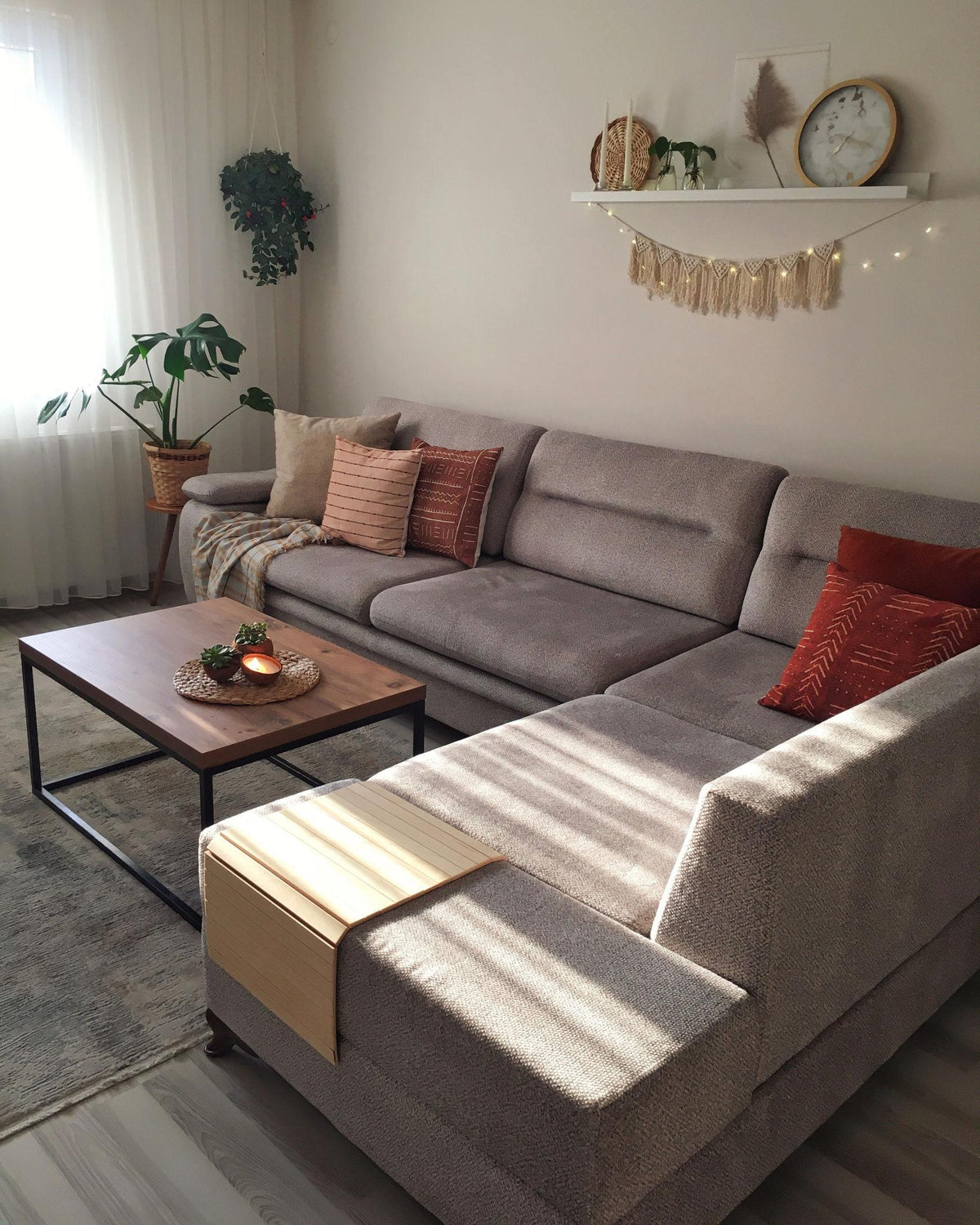
A sofa is usually one of the largest pieces in a living room, so scale matters.
Check:
Overall width — How much wall or floor space will it occupy?
Overall depth — How far will it project into the room?
Overall height — Will it interfere with windows or artwork?
Seat depth — Does it suit the way you like to sit?
Seat height — Will getting in and out feel comfortable?
Also consider nearby furniture.
Leave practical space for side tables, lamps, coffee tables, and walking paths.
The goal isn't simply fitting the sofa into the room.
The goal is making the entire living room continue to function after the sofa arrives.
5. Measuring for a Coffee Table
A coffee table should feel connected to the seating without becoming an obstacle.
Consider:
-
Sofa width
-
Sofa seat height
-
Available walking space
-
Distance from seating
-
Shape of the room
In tighter spaces, round or oval coffee tables can sometimes improve circulation because they remove sharp corners.
In larger rooms, rectangular tables can help visually anchor longer sofas and sectionals.
Think about use as well.
Will you eat snacks there?
Work occasionally?
Store books?
Need drawers or shelves?
Dimensions and function should be considered together.
6. Measuring for a Dining Table
This is where customers often measure only the table itself.
But dining chairs need space too.
And people need space behind those chairs.
Imagine the table during dinner.
Someone pulls the chair backward.
Another person walks behind them.
Can they move comfortably?
Measure the entire functional dining zone — not just the furniture footprint.
If your room has limited space, consider:
Round dining tables.
Extendable tables.
Benches.
Armless dining chairs.
Compact dining sets.
The right configuration can create more usable space without sacrificing comfortable seating.
7. Measuring for Bedroom Furniture
Start with the bed because it usually determines the rest of the room.
Measure the complete bed frame, not only the mattress.
Headboards and frames may extend beyond standard mattress dimensions.
Then consider:
Nightstands.
Dressers.
Bedroom benches.
Wardrobes.
Walking space.
Closet doors.
Bedroom doors.
A beautiful dresser isn't useful if opening its drawers blocks the walkway.
8. Don't Forget Vertical Space
We often think about floor dimensions but forget the walls.
Vertical measurements matter for:
Bookshelves.
Tall storage cabinets.
Wardrobes.
Mirrors.
Wall shelving.
Artwork.
Check ceiling height and make sure tall furniture doesn't interfere with lighting fixtures, trim, vents, or architectural details.
Using vertical space can be especially helpful in smaller homes where floor space is limited.
9. Think About Proportion, Not Just Fit
Furniture can technically fit and still look wrong.
A tiny coffee table may physically fit in front of a large sectional but feel visually lost.
An oversized media console might fit along a wall but overpower everything around it.
Good proportion creates balance.
Look at furniture as a relationship:
Sofa ↔ Coffee Table
Bed ↔ Nightstands
Dining Table ↔ Chairs
TV ↔ Media Console
Desk ↔ Office Chair
Individual dimensions matter.
But relationships matter even more.
10. Check Product Dimensions Twice
Before clicking Add to Cart, review every measurement again.
Compare the product dimensions with your room sketch.
Compare them with your taped floor outline.
Check delivery access.
Check clearance.
Check height.
Then ask one final question:
Will this piece simply fit here — or will it actually work here?
That's the difference between buying furniture and choosing furniture thoughtfully.
THE HOME EDIT Philosophy
At THE HOME EDIT, we believe the right furniture should look beautiful on the screen — and feel even better once it becomes part of your everyday life.
A few minutes spent measuring can prevent disappointment and help you choose pieces with greater confidence.
Because the best furniture isn't simply furniture that fits the room.
It's furniture that fits your life.
Related Collections:
Sofas & Sectionals • Coffee Tables • Dining Tables • Bed Frames • Storage Furniture